Colombian green coffee beans wholesale, from micro-lot to container
To buy Colombian green coffee beans wholesale, you work with a producer or exporter who can ship export-grade lots that pass Federación Nacional de Cafeteros quality control and carry an ICO certificate of origin. Today our verified producer is in Cauca, at 1,800–2,100 MASL, with lots cupping 87–91 points from micro-lot to container volume, and we introduce verified buyers directly at no cost.
This page is available in English and Spanish. You are reading the English version.
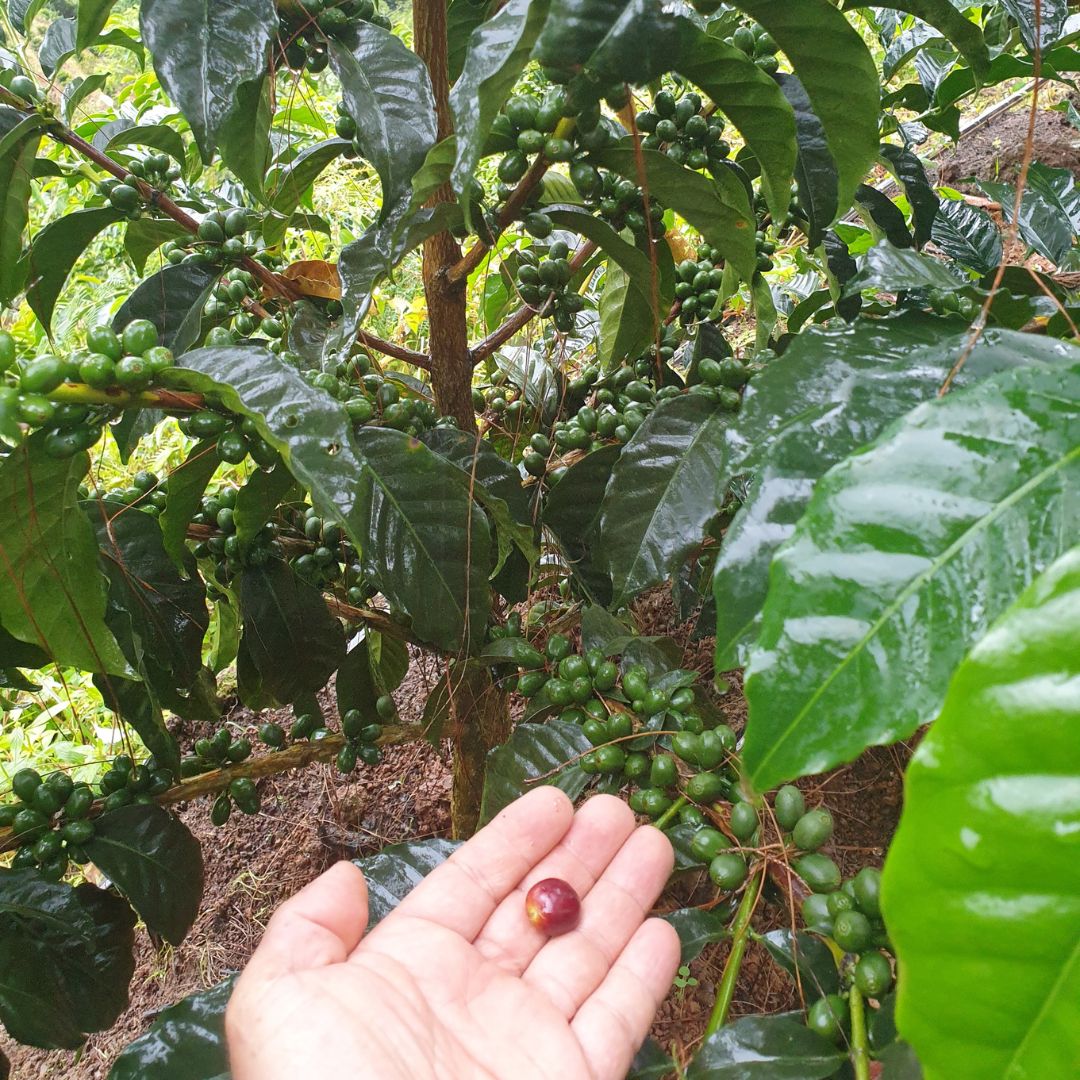
- Origin
- Colombia — Cauca
- Altitude
- 1,800–2,100 MASL
- Varieties
- Geisha · Pink Bourbon · Java · Sudan Rume · Pacamara · Caturra · +3 more
- Processes
- Thermal shock washed · Anaerobic single & double · Koji · Lager yeast · Sugarcane decaf
- SCA cup range
- 87–91 pts
- Volume
- Micro-lots to container volume
- Availability
- By harvest · confirmed lot by lot
- Producer identity
- Shared with verified buyers only
What Colombian green coffee can you buy wholesale?
Colombia exports far more than one generic "Colombian" coffee. For a specialty buyer, the useful split is by lot size and by process. At one end are micro-lots of a single variety and a single process, often a few bags, aimed at competition, seasonal menus or high-end retail. At the other end are consistent washed lots in the 85–87 point range that can fill a container and anchor a blend or a year-round single origin.
These are the processes you will meet most often in Colombian specialty coffee. Of these, our verified producer in Cauca offers thermal shock and anaerobic lots, along with koji, lager-yeast and sugarcane decaf lots:
- Washed: the classic Colombian profile, clean and bright, widely available in volume across the country.
- Honey: part of the mucilage is left on during drying, adding sweetness and body.
- Natural: dried in the cherry, with more fruit and a heavier cup.
- Anaerobic: fermentation in sealed tanks with controlled pH and temperature, for layered, wine-like complexity.
- Thermal shock: hot and cold water treatment after fermentation, known for clarity and vivid fruit. Our thermal shock profile page covers the process in depth.
Colombian coffee regions for specialty green coffee
Colombian specialty coffee is grown in many regions. The cup notes below are the general profiles described by Café de Colombia for four Regional Denominations of Origin in southern and central Colombia. They are a guide to the origin, not a description of our offer; individual lots differ by variety, farm and process. Today our verified producer is in Cauca.
If you need a different origin, tell us which one you are looking for when you request access.
- Cauca: high acidity, medium body, a balanced cup with sweet and floral notes. Our verified producer farms here at 1,800–2,100 MASL.
- Huila: balanced, sweet, with acidity and medium-to-high body and fruit and caramel notes. Café de Colombia places Huila coffee between 1,000 and 2,200 MASL.
- Nariño: high acidity, medium body, a clean, soft cup with sweet notes and pronounced aroma.
- Tolima: medium-high acidity, clean and soft body, sweet flavors with citrus and fruit notes.
How does coffee export from Colombia work?
Every export of green coffee is controlled. The exporter must be registered with the Federación Nacional de Cafeteros (FNC), announce each shipment and pay the coffee contribution. At the port or airport, Almacafé, the FNC's logistics and quality arm, samples the coffee and issues a re-weighing certificate and, for excelso grades, a quality certificate.
For excelso, FNC rules (Resolution 05 of 2002, with later amendments) set requirements such as moisture of no more than 12%, a maximum number of defective beans per 500 g sample, no live insects, and a clean cup free of fermented, chemical or moldy taints. Since 2015, coffees of qualities other than excelso can also be exported under separate rules.
The FNC then issues the ICO certificate of origin once the contribution is paid. ICO rules require every coffee export to be covered by this certificate, and each bag carries an ICO mark: a country code, an exporter code and a lot number. That mark is how you trace a parcel back to its shipment.
Common commercial terms: FOB, EXW, samples and contracts
Terms are agreed lot by lot between buyer and exporter; we do not set or promise them. These are the ones you will see most often:
- FOB (Free On Board): the seller clears the coffee for export and loads it at the Colombian port, usually Cartagena, Santa Marta or Buenaventura. Freight and insurance from there are yours.
- EXW (Ex Works): you take the coffee at the warehouse or mill and handle everything after, including export, which in Colombia requires a registered exporter.
- Samples: pre-shipment samples for approval before contracting, and arrival samples to confirm the lot matches. Courier shipments are the usual route for samples.
- Contracts: lot, variety, process, quantity, quality specification, price basis, Incoterm, shipment window, payment terms, tolerances and how claims are handled.
Colombian coffee harvest seasons: main crop and mitaca
Colombia harvests for much of the year because its regions sit at different latitudes and rainfall patterns. Cenicafé describes two harvest peaks in the central coffee zone, April to June and September to December, with the larger one called the main crop and the smaller one the mitaca or traviesa.
In the south the pattern shifts: Cenicafé groups Nariño, Cauca, Tolima and Huila among the departments where the main crop generally falls in the first half of the year, while parts of Huila, Tolima and Cauca have two harvests of similar size. In practice, ask the producer for the actual harvest and shipment window of the lot you want.
Documents to request before you buy
Whoever you buy from, ask for these before committing to a lot. A serious exporter will provide them without hesitation.
- Lot sheet: farm region, altitude, variety, process, harvest date, moisture and screen size.
- Cupping record with score and protocol used (SCA scale; 80+ is specialty).
- Pro forma invoice with Incoterm and shipment window.
- Commercial invoice and packing list.
- ICO certificate of origin and FNC quality or re-weighing certificate.
- Bill of lading (sea) or air waybill.
- For EU buyers: plot geolocation and traceability data required under the EU Deforestation Regulation.
How sourcing through our network works
We are a sourcing desk, not an exporter or a marketplace. We connect international buyers with verified specialty producers, and the buyer does not pay for the connection. Today our network has one verified producer, in Cauca, with national champion lots, lots used by World Brewers Cup competitors and on-farm microbiology and quality labs. The network is expanding through producer applications, and producer identity stays private until you are verified.
- Request access with your company, market and the volume and profile you need.
- Verification: we confirm you are an active roaster, importer or coffee chain.
- Discovery call to define lots, processes, volume and timing.
- Direct introduction to the producer, so you negotiate samples and terms with them.
Frequently asked questions
What is the minimum order for Colombian green coffee?
+
For full programs the typical minimum is around one metric ton, which suits sea freight. Our verified producer in Cauca also offers micro-lots, which usually ship by air. Final quantities are agreed directly between you and the producer or exporter.
How can I buy coffee beans from Colombia directly?
+
You need a producer with export capacity or a registered exporter working alongside them, a sample approval process and a contract with a clear Incoterm. We introduce verified buyers directly to our verified producer in Cauca, so you build the relationship yourself instead of buying through anonymous stock lists.
Do you publish prices for green coffee?
+
No. Prices depend on the lot, process, cup score, volume, Incoterm and the market at the time of contracting. They are quoted by the producer or exporter after the introduction, once your volume and specifications are clear. We do not add a margin for the buyer.
Can I get samples before buying?
+
Yes. Requesting samples is standard practice before any contract. After the introduction, the producer sends pre-shipment samples so you can roast and cup them on your own protocol. For larger contracts, it is also common to approve an arrival sample.
Is Colombian green coffee good for roasting at home?
+
We serve businesses, not home roasters. We work with roasters, importers and coffee chains buying from micro-lot to container volume. If you roast commercially, request access and tell us your volume and profile so we can check whether there is a fit.
Sources
- Federación Nacional de Cafeteros — Resolución 05 de 2002 (calidad del café verde de exportación)
- FNC / ProColombia — Cartilla: aspectos para exportar café desde Colombia
- International Coffee Organization — Rules on Certificates of Origin (ICC-102-9 Rev. 5, 2022)
- Cenicafé — Cartilla 19: Recolección de café (épocas de cosecha por región)
- Café de Colombia — Regional Denominations of Origin
- Specialty Coffee Association — Protocols & Best Practices
Related profiles
- VARIETY PROFILE · GEISHAGeisha coffee from Colombia: green lots for roasters and importers
- VARIETY PROFILE · PINK BOURBONPink Bourbon coffee: Colombian green lots for roasters and importers
- PROCESS · THERMAL SHOCK · GREENThermal shock coffee: how to buy green lots you can repeat
- PROCESS · ANAEROBIC · GREENAnaerobic coffee: what it is and how to specify a green lot